Showing posts with label fashion history. Show all posts

4.12.2011

fashion photography

top: Sebastian Smith
bottom: Richard Avedon

**experimenting with illustrator and photoshop more and more...i'm getting addicted!**

2.22.2011

ALEXANDER McQUEEN: SAVAGE BEAUTY

It was announced quite some time ago that the theme for this year's Costume Institute Gala and accompanying exhibition would pay tribute to the late Alexander McQueen and his extraordinary body of work. Today, The Met's director, Tom Campbell and curator: Andrew Bolton unveiled some images in anticipation of the exhibition which opens to the public on May 4th.

1.31.2011

Pulp Fashion: Isabelle de Borchgrave

The Legion of Honor Museum in San Francisco has announced that their exhibition "Pulp Fashion: The Art of Isabelle de Borchgrave" will open February 5th and run through June 5th and will be the most comprehensive exhibition of the artist's work. Borchgrave has been working over the last 15 years; creating the most exquisite reproductions of various historical costumes; using paper as her sole form of textile.  She manipulates and colors paper to create each piece, and the end result is 'tromp l'oeil' in its truest form. I'm hoping to get get out to the west coast at some point this spring/summer to see this!


-all photos courtesy of: www.isabelledeborchgrave.com-

11.17.2010

lobsters!

Recently saw this photo of Dree Hemingway from Vogue Italia and was immediately reminded of a photo of the infamous Isabella Blow (images of her are currently swimming in my head from all the recent publications controversy)... After comparing these images, I immediately recalled my fashion history and thought of Elsa Schiapiarelli's prolific work using the lobster as her muse. She has such an intriguing body of work, I may have to dedicate a post just to her in the near future.
                 -Hemingway in Vogue Italia-                                                         -the iconic Isabella Blow-
-this speaks for itself-

Schiapiarelli was a significant contributor and collaborator to the Surrealist movement and worked with Salvador Dali (who also used lobsters in his lobster telephone).
-Lobster Telephone, Salvador Dali, 1936-
-Lobster Telephone (aka Aphrodisiac Phone), Salvador Dali, 1936-
-Lobster Dress, Elsa Schiapiarelli, 1937-
-Lobster Dress, unknown designer-
-Tear Dress, Salvador Dali and Elsa Schiapiarelli, 1938-
-Skeleton Dress, Elsa Schiapiarelli, 1938-
-Gala (wife of Salvador Dali) in a Schiapiarelli hat-
-the women herself, Schiapiarelli, in her Paris Salon-

11.10.2010

Costume Institute 2011 + Alexander McQueen

So.... the announcement for the Spring Costume Institute exhibition at The Metropolitan Museum of Art has been made and this year's gala and exhibition will be dedicated to the work of the late Alexander Lee McQueen.  Whether they had been planning on doing an exhibition solely dedicated to McQueen's work or whether his sudden passing was a catalyst for the presentation, is unknown. As McQueen's work is intensely theatrical and over the top not only in design but scale, it will be interesting to see how the curators will execute an effective exhibition on his body of work.  The exhibition will span McQueen's career beginning with his Senior Collection for Central Saint Martins from 1992 until his death in February 2010.  It will also feature garments from his time as head of Givenchy.  The exhibition will open on May 4th, with its annual Gala, known ("Party of the Year") taking place on Monday, May 2nd.  This year's exhibition is chaired by Francois-Henri Pinault of the Gucci Group and his wife, Salma Hayek and co-chairs for the event are Colin Firth, Stella McCartney and Anna Wintour.

11.08.2010

Balenciaga + Queen Sofia Institute

A new exhibition dedicated to the work of Balenciaga and the ongoing history of the brand will be on view beginning November 19th, at the Queen Sofia Spanish Institute in NYC, and will run through February 19th next year. Curated by Hamish Bowles, of Vogue fame, BALENCIAGA: Spanish Master pays tribute to Critobal Balenciaga (1895-1972), one of the most important and prolific Spanish designers to impact the aesthetic landscape of modern fashion design.  The exhibition will feature over 70 clothing and accessory items from the archives at the House of Balenciaga in Paris and other prominent collections from both America and Europe.  Highlights in the exhibition include the famous "Infanta" dress from 1939, matador boleros from 1946 and flamenco style dresses from 1951 and 1961. A catalogue authored by Hamish Bowles will accompany the exhibition and it is already scheduled to travel to San Francisco to make its next stop at the deYoung Museum beginning in March of next year.
-Left: Infanta Dress, 1939; Right: Evening Dress and Stole, 1952-
-Left: Flamenco-inspired dress, 1951; Right: Ensemble with toreador bolero, 1946-
-Images from NYmag-

10.06.2010

Pierre Cardin + Gareth Pugh

Continuing on the theme of the 1960's, Pierre Cardin recently celebrated the 60th anniversary of his brand and at age 87, he is still going strong.  Some of the most significant contributions Cardin made to fashion were his forward thinking designs of the 1960s.  As mentioned in the previous post, the Space Race was an event heard all around the world. Cardin was working out of a Paris studio, but his fashions were seen splashed all over the pages of American fashion publications.  Although utilizing bright, bold colors for his futuristic designs, Cardin was a key player in solidifying the color white to be a signifier of the future. His designs in white are stark, with clean lines, minimal detailing... a kind of utopian ideal.  First, some of his more vibrant and spunky looks... followed by a starkly contrasted series of black and white images of his white collection of 1970.
-Pierre Cardin, 1967-

-Nurse's Uniforms, 1970, with Pierre Cardin-
Cardin's seems foundational to the inspiration for Gareth Pugh's work. Pugh has defined himself as a futuristic designer, not only in form but in presentation as well.  Pugh favors video presentations to live runway shows and has produced some stunning work.  His recent Spring/Summer 2011 Collection, presented designs almost entirely in white...although this is nothing new for Pugh... he seems to take this idea to the extreme this time.  The idea of "futuristic," has evolved into something almost otherwordly, but it still recalls back to the ideals Cardin instilled during the 1960s.  In the same way that the clothes in Cardin's 1970 collection form a cocoon around the body, Pugh's garments also look as though they were built to protect the body from unknown futuristic elements.


9.29.2010

daily wear

It's interesting to think about how much fashion has changed over the centuries. I was hanging out with a friend the other night talking about wanting to have an occasion to wear a ball gown to.  In today's society, it is quite rare where one has the occasion to dress up so formally.  Other than one's wedding day... you would be hard pressed to find another excuse.  However, what we, in the contemporary world, consider uber-fancy was once considered everyday dress. Yes, I am usually talking about the elite here, most of fashion history is a documentation of the elite dress at any given point in time.  One of my favorite periods in costume history to study is 18th and 19th century France.  Learning the history of extravagance, political implications, and larger-than-life personalities will take you a lifetime.

I've always loved this portrait of Empress Eugenie, wife to Napoleon III, by Franz Winterhalter (1854) at The Met. The style of her dress is classically 18th century though.  Eugenie was known to have a strong affinity, obsession even, with the late Marie Antoinette and is trying to emulate her in this official portrait.  Her hair is powdered white, and Eugenie would have had naturally raven hair as she was from Spain.  Her dress is ornately decorated with lace edges and black ribbon bows.  To have black fabric in those days was a sign of luxury.  True black garments were costly to dye and necessitated a labor-intensive and timely process.  Her dress is adorned with various strings of pearls and we can assume that the vibrant yellow and blue satin trim fabrics would have been of the highest quality.  The lace and fringe trimmings are also probably the best hand-made products.

Although Eugenie loved to emulate fashions of the past, she was a tastemaker in her own right.  In this portrait, you can see that she makes a 19th century addition to the 18th century style dress with the cage crinoline.  Eugenie is often attributed as setting the trend for wearing cage crinolines, and loved the trend of voluminous skirts.  She was an important patron for Charles Frederick Worth, known as the first couturier.
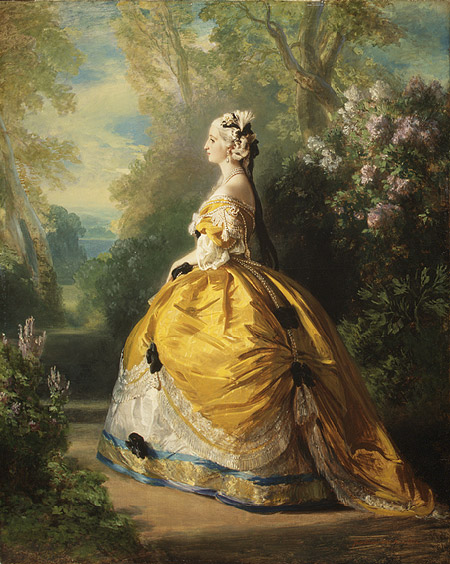
-metmuseum.org-
Franz Winterhalter, 1854, oil in canvas


This second image portrays Eugenie very similarly to the portraits we saw of Marie Antoinette in her Trianon days: wearing loose white muslin dresses.  This portrait looks a bit more Victorian in its decoration, and her hairstyle, with the sides lying slightly over the ears, is more modern as well.  The silhouette of the sloping shoulders and dress hanging delicately on the arms is a familiar 19th century look.
-Hillwood Museum-
Franz Winterhalter, 1857, oil in canvas

9.21.2010

herrera + hanbok

Taking a step back into New York Fashion Week, I had to post something about Carolina Herrera's hanbok-inspired Spring 2011 collection.  Everything from the straw hats, bow detailing, patterned textiles, and garment construction took direct cues from Korean traditional clothing, known as a hanbok.  Herrera mixed elements from both men's and women's clothing and added her signature style to create a beautiful collection.  Each look is wearable and provides an alternative for the traditional European empire waist consumers may be use to. First, some menswear inspired looks; the first being a stark-white modern take on the traditional casual daily wear. Both with the black woven hat.

The assymetrical bow detailing is a characteristic unique to the hanbok, as well as the voluminous skirt. A multi-layered underskirt is worn underneath the hanbok skirt to add volume.  Herrera achieves a similar effect in her gowns; which still are relatable enough for her audience.  Check out all the images from the collection here.
        
 
(Carolina Herrera images from elle.com)

Just for your viewing pleasure, some of my favorite contemporary interpretations of the hanbok. so dreamy~
(weddinginspirasi.com)
Song Hye Gyo for Vogue Korea, June 2007

me, age 2, washington heights, ny
in our hanboks on our wedding day